DECEMBER 2025
Dear Network Members,
This month marks the conclusion of the 30th Conference of the Parties (COP30), which took place in Belém, Brazil. With estimates suggesting that the current agri-food system is responsible for a quarter to a third of global carbon emissions, we dedicate this issue to bringing you critical voices from COP30—particularly those of Indigenous communities. While indigenous voices are excluded or marginalised from these negotiations, they live at the forefront of the climate crisis, bearing the brunt of ongoing deforestation in the name of food security and experiencing displacement caused by technocratic climate mitigation and adaptation interventions.
Alongside the official climate negotiations, a “Peoples’ Summit” was held, bringing together a broad coalition of social movements—over 70,000 participants in total. The Belém Declaration, its final statement, reflects their shared political vision for climate action rooted in social justice, human rights, and ecological protection. This stands in stark contrast to the complete lack of ambition in the COP30 final text, which fails even to mention “fossil fuels,” due to intense lobbying from oil-producing interests.
In addition to news on COP30, we are delighted to introduce two new members of the Agrofutures team. Ana Cabrera Pacheco, from the Secretaría de Desarrollo Sustentable (SDS-Yucatán) in Mexico, and Büşra Üner, from University of Bayreuth, have joined Arianna Tozzi and Enid Still as editors of the newsletter. They bring critical perspectives on agroecology movements from Latin America and West Asia, as well as a fresh new approach to our editorial work. A warm welcome to Ana and Büşra!
We hope you will enjoy the newsletter!
Warmly,
The Agrofutures Team
ACADEMIC ARTICLES
Rahman, A., 2025. The Price of Resilience: How Climate Capitalism Exploits Coastal Lives in Bangladesh. Capitalism Nature Socialism, pp.1-7. https://doi.org/10.1080/10455752.2025.2581104
Camargo, A. and Ojeda, D., 2017. Ambivalent desires: State formation and dispossession in the face of climate crisis. Political Geography, 60, pp.57-65. https://doi.org/10.1016/j.polgeo.2017.04.003
BOOKS
Professor Farhana Sultana’s concept on Climate Coloniality remains a key tool to explore how ongoing legacies of colonialism, imperialism, and capitalism co-produce the present climate crisis, influencing global and local responses in uneven ways. Here is a link to a an edited collection of essays exploring these themes alongside Sultana’s seminal article
SOCIAL MEDIA
In the COP30 venue, at least one thing went right. The food offered to delegates, negotiators, civil society, and workers came directly from family farming, agroecological production, and Amazonian socio-biodiversity. It was 100% agroecological and culturally rooted, on top of being nutritionally balanced. Na Mesa da COP30 (COP30 Food Initiative) were in charge of bringing this project to life during the COP30 in Belém. They brought more than 40 partner organizations to put in practice the meaning of agroecology and food sovereignty: “relationships, governance, and shared purpose” besides production methods. Even then, some critiques went into the cost of the meals, which a Brazilian person with an average salary would not be able to afford. First, second, and third steps are being taken around the world to bring forward climatic (and food) justice, but it is not quite yet enough. Let’s keep walking together and making things better for our people and our territories.
This is based on and inspired by: Matheus Alves Zanella (Matheus Alves Zanella’sLinkedIn post) and FAO’s Agroecology Knowledge Hub’s post.
MEDIA ARTICLES
An investigation published in the Guardian revealed how more than 300 big agriculture lobbyists have taken part in COP30 climate negotiations this year. The number of lobbyists representing the interests of industrial cattle farming, commodity grains and pesticides is up 14% from last year, remarking the powerful influence of the agri-food sector in the regions.
You can also read this statement by the Women and Gender Constituency on the Belem declaration outlining the specific gender and intersectional impact of the latest COP-30 negotiations.
PODCASTS
The Indigenous Climate Hub Podcast Series brings you powerful stories from Indigenous voices on the frontlines of climate change in Canada.
EVENTS & TRAINING
The Journal of Peasant Studies (JPS), invites application for the International Writeshop in Critical Agrarian Studies and Scholar-Activism for PhD students and relatively early career researchers (up to 5 years from PhD completion) who are based in, or are originally from, the Global South. For applications and timeline please see here. Successful applicants must circulate a draft manuscript (based on their accepted abstract) of 8,000-10,000 words in advance of the Writeshop.
CALL FOR PAPERS
The call for papers for the next conference of the Association for an Anthropology of Social Change and Development (APAD) is now open. The conference will take place from 27 to 29 May 2026 at the Catholic University of Central Africa (UCAC) in Yaoundé, Cameroon. The theme of the conference is ‘Extractivism, resistance and alternatives in a globalised world’ Call for papers is now open here. Paper proposals must be submitted before the 30th of November 2025.
Call for abstracts Addressing current and future challenges of work in agriculture: research, policy and practice at International Symposium on Work in Agriculture, 7-10 July 2026, Berne, Switzerland. The symposium covers the following themes:
Attractiveness of work in the agri-food sector
Decent work in the agri-food sector
Knowledge, skills and education
Dynamics of work
Health and safety
Agricultural workforce development systems
Abstract submission is open until 11 January 2026. Decisions on acceptance will be communicated by 15 February 2026. To submit your abstract, follow this link.
AGROECOLOGY AND ART
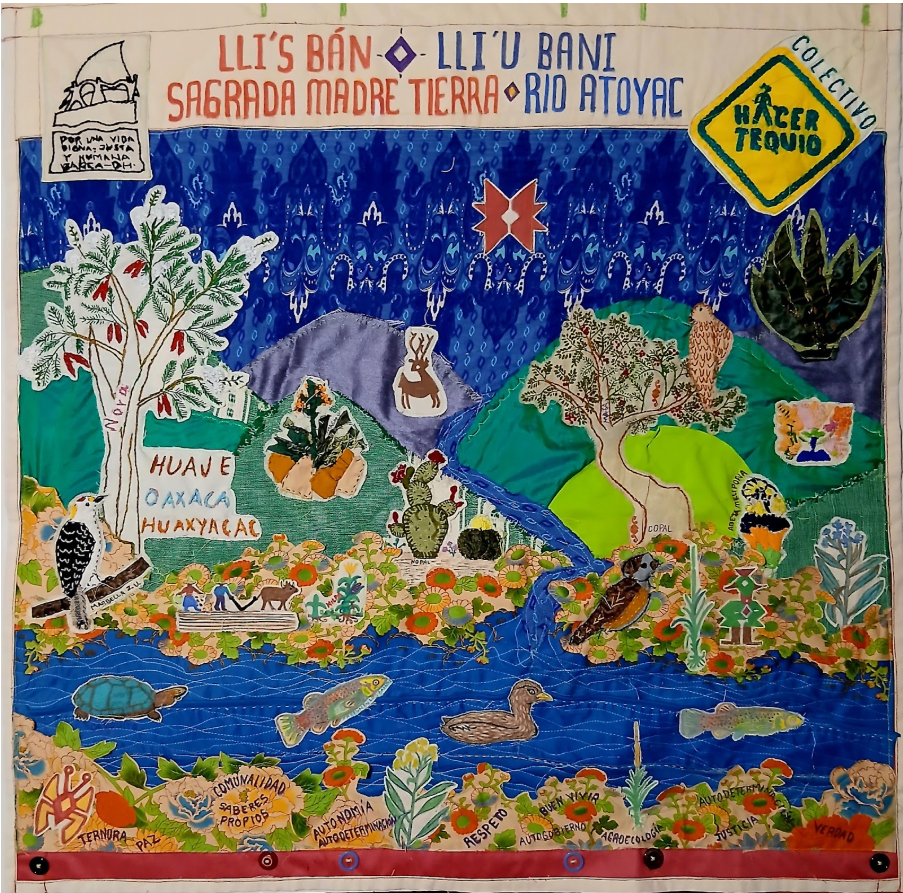
The cover image for today’s newsletter is from Hacer Tequio Colectivo, a collective in Oaxaca, Mexico. The piece was sent to the COP 30 and the People's Summit and installed in the "Bosque de Esperanza" (Forest of Hope) showcase. More info and art https://www.instagram.com/zurciendoelplaneta/
Esperanza por un río Atoyac vivo en Oaxaca” (Hope for a Living Atoyac River in Oaxaca) by Hacer Tequio Colectivo, link