JANUARY 2026
Dear Network Members,
Happy New Year! We hope you had a nice break and are ready to embrace the joys (and challenges) of the new year. We want to thank all of you for your contributions to the conversations across the network this past year and wish to keep them ongoing throughout 2026.
As always, we’ve selected a few articles, news stories, and other updates that we hope you’ll find interesting. Please keep sharing relevant material and spreading the word about this initiative within your circles.
Warmly,
The AgroFutures Team
ACADEMIC ARTICLES
Reddy D. S. and Ramkumar, A. 2025. Tamil Nadu’s heritage rice, lost and found. Contemporary South Asia, 33(4), 721–747. https://doi.org/10.1080/09584935.2025.2575154
Vizuete, B., García‐Llorente, M., Pérez‐Ramírez, I., & Oteros‐Rozas, E. (2025). Gender equity as a key element for agroecological transitions: Neo‐rural women as managers of agroecological initiatives. People and Nature, 7(2), 449-462. https://doi.org/10.1002/pan3.10761
Ume, C., Wahlen, S., Nuppenau, E. A., & Domptail, S. (2025). Women smallholders build an agroecology food system: the construction of empowerment and food sovereignty. The Journal of Peasant Studies, 1-21. https://doi.org/10.1080/03066150.2025.2462760
BOOKS
Wright, J. (ed.) (2021). Subtle agroecologies: farming with the hidden half of nature. Taylor & Francis. https://www.taylorfrancis.com/books/oa-edit/10.1201/9780429440939/subtle-agroecologies-julia-wright?_gl=1*zt1dgj*_gcl_au*Njc5ODU0MTg1LjE3NjQ2MTEyMjU.*_ga*MzA3MjIzMTczLjE3NjQ2MTEyMjc.*_ga_0HYE8YG0M6*czE3NjU5MDc1MzUkbzMkZzAkdDE3NjU5MDc1MzUkajYwJGwwJGgw
Book review avalable here: Rigolot, C. (2022). Subtle agroecologies: farming with the hidden half of nature: edited by Julia Wright, Advances in Agroecology, CRC Press, Taylor and Francis Group, 384 pp., US$160.00 (hardback), ISBN 9781138339811. Agroecology and Sustainable Food Systems, 46(4), 642–646. https://doi-org.eux.idm.oclc.org/10.1080/21683565.2022.2028216
THESES
Lucía Demicheli Audi (2025). Bridging feminist agroecology and justice frameworks: theoretical foundations for gender-transformative food system transitions. MSc Thesis in Resilient Farming and Food systems. Wageningen University. https://edepot.wur.nl/703016
MEDIA ARTICLES
FAO launches International Year of Woman Farmer 2026 to accelerate gender equality in agrifood systems - a global campaign aimed at recognizing women’s indispensable yet often overlooked contributions to global agrifood systems and to galvanize efforts to close persistent gender gaps. As we can see in the website: “Women farmers work in diverse roles across agrifood systems and come from all backgrounds: young and older women, Indigenous women, women in local communities, women with disabilities, and refugee and displaced women. They are smallholder producers, peasants, agricultural laborers, fishers and fish workers, beekeepers, pastoralists, processors, traders, women in agricultural sciences, rural entrepreneurs, traditional knowledge holders, and more—whether in formal or informal work, with or without land ownership.” More information here.
“The path to feminist agroecology” by Marta Soler Montiel, Marta Rivera-Ferre and Irene García Roces (2020). Agroecology, food sovereignty and feminism are concepts that together provide a new and critical perspective on food and farming. They can help us to understand the world and push us into action. But what exactly do they mean? And what can we do? In this article, the authors present three critical proposals. Have a look here.
"Civil society call for the urgent release of La Via Campesina's members in Palestine" - Farmers, who take care of their land,territory and seeds, have been systematically targeted in recent months by settlers and Israeli occupation forces. These attacks against a peasant organisation are aimed to destroy their food sovereignty and contribute to the genocidal enterprise against the Palestinian people. This attack is also a serious violation of Palestinian farmers’ right to organise. More information here.
PODCASTS
“A journey through feminist agroecology”: Throughout the podcast mini-series, activists, researchers and practitioners who dedicate their lives to feminism and agroecology share how women (and others) are invisibly sustaining the food system, what it means to place ‘life’, rather than profit, in the centre of the food system, and what food systems would look like if they were based on feminist values. Listen here (English & Spanish).
CALL FOR PAPERS
The journal Urban Agriculture & Regional Food Systems is pleased to announce a call for papers for a special issue on Agroecology and Urban Ecosystems, focusing on the intersection of agroecological practices and urban environments. This special issue aims to bring together cutting-edge research from early career researchers exploring the dynamic interplay between agroecology, urbanization, urban planning, urban ecology, and urban ecosystem services. Submissions open: April 1st, 2025. Submission deadline: April 30th, 2026. Manuscripts should be submitted through the Urban Agriculture & Regional Food Systems ScholarOne submission portal. For any queries regarding this call for papers, please contact the editorial team at ua@sciencesocieties.org. More information here.
JOBS, STUDENTSHIPS & GRANTS
Towards Equitable Sustainability Transitions (TEST) Lab at Western University in Canada is looking to onboard a few students to work on projects related to community-directed climate adaptation in collaboration with land-based community partners. Please share with anyone who may be interested. Useful links here & here.
Reminder! An exciting new PhD (fully funded) has been announced as a collaboration between the London School of Economics and the Royal Botanic Gardens, Kew on Planting Decolonization: Plantation Science and Empire in the Twentieth Century. The PhD offers the opportunity to investigate the interconnections between science at Kew, industry and empire in the mid twentieth century. More info here. Closing date is 14 January 2026. Informal enquiries can be sent to k.paprocki@lse.ac.uk and m.nesbitt@kew.org.
The AGROECOLOGY Partnership has announced that their third co-funded call is NOW OPEN: "Fostering plant and animal genetic diversity and empowering farmers to accelerate the agroecological transition”. This call focuses on two key pillars of the agroecological transition: the genetic and the social dimension. The partnership will fund R&I projects providing significant contributions to either one of the following two topics: Topic 1: Enhancing the genetic diversity and variability of crops and livestock for the agroecological transition. Topic 2: Strengthening farmers’ involvement and empowerment in the agroecology transition. For detailed guidance on each step and for all call documents, please refer to the submission website. The co-funded call is conducted as a two-step-procedure. As a first step, a pre-proposal has to be submitted. If this pre-proposal is successful, the Coordinator receives an invitation to submit a full proposal. The deadline for the first step is 18 February 2026.
EASA 2026 (The European Association of Social Anthropologists) conference in Poznan (21-24 July 2026): Ecofeminist Ethnographies of "Green" Energy Projects: Destabilising Colonial Structures in European Energy Transitions (roundtable). The aim is to critically examine how Europe's "green" energy transition—through lithium mining, hydrogen corridors, solar farms, and electric vehicle adoption—often reproduces colonial and extractive logics, displacing communities and transforming local worlds, livelihoods, and relations of care. Grounded in ecofeminist and decolonial thought, we seek to move beyond critiques of "green growth" to actively imagine energy futures based on reciprocity, repair, and shared vulnerability. The roundtable format will be hybrid (in-person and online participation) and the submission deadline for contributions (250 words) is 26 January 2026. This and other panels can be found here. The Call for Papers is now open and closes at 23:59 CET on 26 January 2026.
AGROECOLOGY AND ART
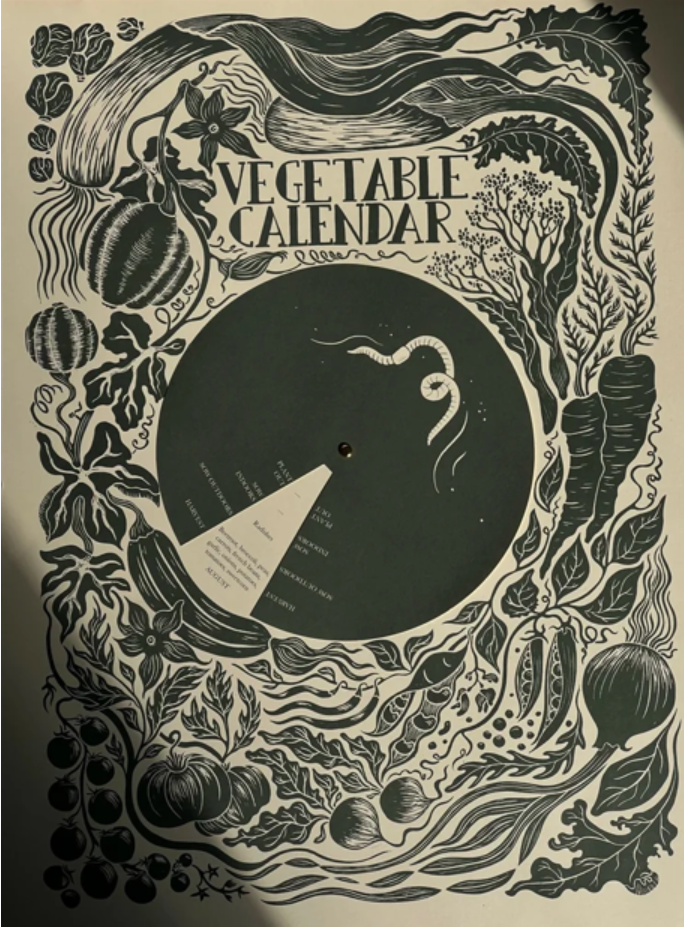
Fantastic art by Emma Reith! This piece is called “Vegetable Calendar”. From her website: “The circle in the middle is split into 12 sections - one for each month - and each month is divided into what you can harvest, sow outdoors, sow indoors, and plant out in your vegetable patch. Spin the wheel to reveal the current month, and see what you can plant!”