FEBRUARY 2026
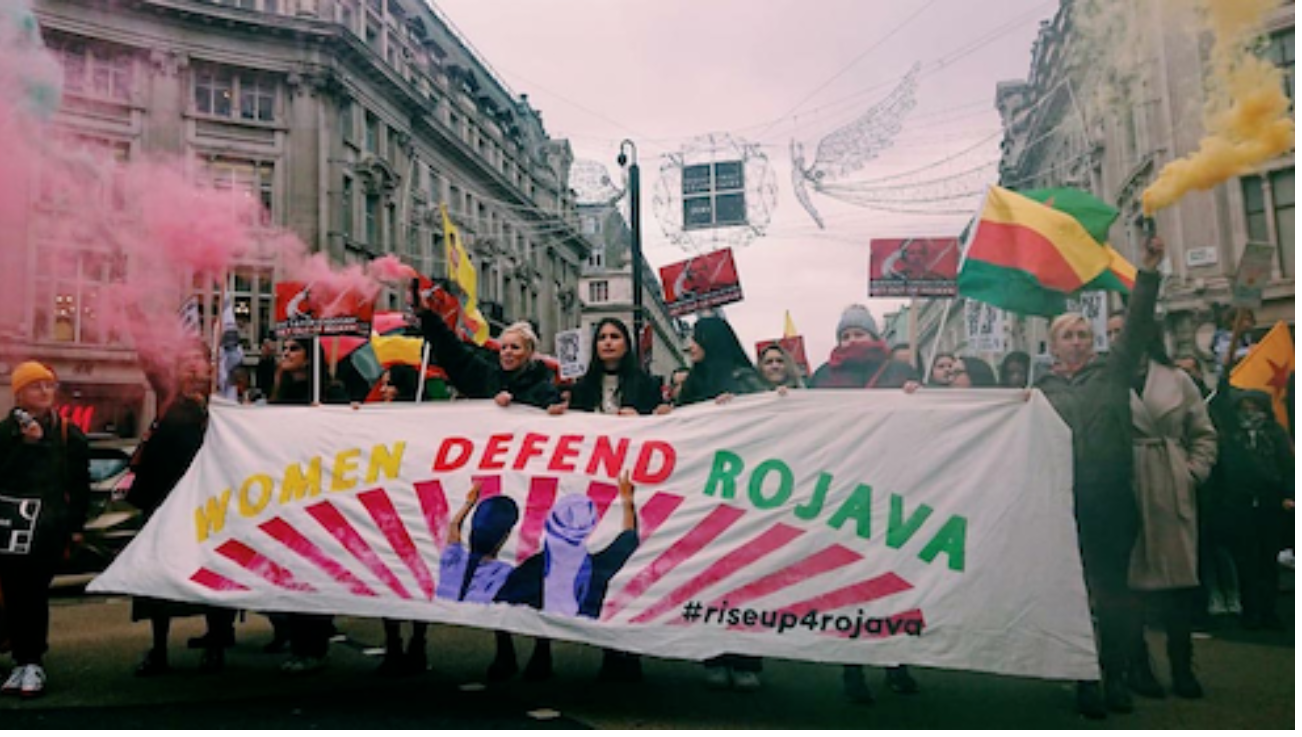
“Raise your voice for Rojava: Defend women, freedom, and humanity” link for the photo.
Dear Network Members,
As we prepare this month’s newsletter, the world is being reshaped by the tremors of war, genocide, and the rising tide of social movements. In North and East Syria (Rojava), Iran, and Palestine, continuous displacement and violence are not only claiming human lives but are also resulting in “ecocide”—the destruction of ecological knowledge and the loss of vital seeds and plants. Yet, in the face of this destruction, women are pioneering social movements to defend their rights and territories.
Rojava, an autonomous region built upon a women's revolution and the principles of ecological and gender justice, currently faces an existential threat; feminists worldwide are now acting in solidarity with those under attack by Hay'at Tahrir al-Sham (HTS), an Islamist political group involved in Syrian civil war. Similarly, in Iran, military forces have killed many of those resisting to overturn the government. Due to state-mandated internet shutdowns, transparent information remains difficult to access, yet we know that women continue to play a central role in the protests. Consequently, this month’s newsletter is dedicated to the intersections of war, genocide, social movements, and feminist agroecology. To deepen our collective understanding of this theme, we have curated a selection of academic articles, books, podcasts, and videos below..
We hope this month’s theme will stimulate reflections and conversations and please share relevant material among members of the Network that add to the conversation. We appreciate your active contribution and would like to make the Network a safe space for discussion on these topics.
Warmly,
The AgroFutures Team
Academic articles
Dinç, P., Nardi, M.A. & Hamza, M. (2025). Environmental politics in North and East Syria/Rojava: A scoping and conceptual literature review. Studies in Ethnicity and Nationalism, 25(3), 1-16. https://doi.org/10.1111/sena.70005
Ghoreishi, K. & Minelli, S. (2025). Rojava: Politics of revolutionary hope. Journal für Entwicklungspolitiks, 41(2), 58-74. https://doi.org/10.20446/JEP-2414-3197-41-2-58
Books
Hunt, S. E. (ed.) (2021). Ecological solidarity and Kurdish freedom movement: Thought, practice, challenges, and opportunities. Lexington Books. https://books.google.de/books?hl=tr&lr=&id=YX1EEAAAQBAJ&oi=fnd&pg=PA299&dq=rojava,+feminist+agroecology&ots=Szz-tNdNuI&sig=gcnUva2E-Wpyv6u53glZzPelQsg&redir_esc=y#v=onepage&q&f=false
Media articles
Following the U.S. intervention in Venezuela to seize control of the state and its oil resources, the Araña Feminista network declared on January 3, 2026: “This attack is a violent, desperate response from a global patriarchy that fears the construction of a communal state—one where power ceases to be a male-led pyramid and instead becomes a horizontal fabric of care and collective decision-making.” Read the full announcement here.
While we witness the brutal physical destruction of lands across the Global South, the Transnational Institute’s latest report, 'The Pillars of Repression: Part 3,' exposes the internal front of this global war. It documents how states like Germany are constructing a repressive infrastructure designed to dismantle the very solidarity movements that defend our collective life and ecology. This securitization of dissent is not merely a political crackdown; it is an attempt to tear the horizontal fabric of resistance that binds our local struggles to the global defense of territory and truth. Read the full report here.
Call for Solidarity
The universities of North and East Syria, including the University of Rojava, Kobanî University, and the University of Al-Sharq, have issued a joint statement calling for global solidarity to defend the region. Read the full statement here.
Rojava currently faces an existential threat from the coordinated assaults of HTS and ISIS, which target the very heart of the Women’s Revolution and its foundations of grassroots democracy and pluralism.In a powerful wave of mobilization, Kurdish youth and women have responded by the thousands, traveling to the frontlines to defend their territory alongside a global network of social movements, trade unions, and academic communities. Uniting across borders, 183 organizations and 72 individuals from 39 different countries stand together to declare:
“January 26th, 2026 | Kobanê Action Day: We return to the streets to defend the city that first broke ISIS. As dark forces place Kobanê under siege once again, we call for decentralized actions to protect this symbol of global victory over terror.
January 31st, 2026 | Women Defend Rojava: We call upon all women to mobilize under the banner of “Women Defend Rojava.” Let us stand as a global shield for the revolution, proving that the struggle for a life of dignity knows no borders. Jin, Jiyan, Azadî!” More information and read the full statement here.
The Landworkers’ Alliance has declared its firm solidarity with the people of Rojava, condemning the genocidal assaults and territorial invasions launched by the Syrian Transitional Government (STG). This offensive—led by the former HTS commander Ahmed al-Sharaa—is not merely a military maneuver; it is a calculated strike against the very existence of the Kurdish people and the pluralistic, democratic model they have built over the last 15 years. By targeting the land-based achievements of the revolution, the STG and its backers threaten to dismantle the hope that Rojava represents for agroecology, gender liberation, and grassroots sovereignty everywhere. Read the full statement here.
Podcasts and videos
This episode, “Agroecology in Rojava,” of The Poor Proles Almanac invites into a deep conversation with Berivan Omar, a Kurdish feminist activist and social ecologist based in North and East Syria, and Anna Rebrii, an author and organizer with the Emergency Committee for Rojava. Together, they explore how the principles of social ecology and agroecology are being woven into the horizontal fabric of the Rojava Revolution as a means of survival and resistance. Beyond discussing the region's current struggles against state violence, they provide a preview of their work in the book Rojava in Focus: Critical Dialogues (AK Press), offering an essential perspective on how gender liberation and ecological justice serve as the foundations for building a communal life amidst the chaos of war. Listen the podcast here.
In this video, Yara Dowani, a permaculturist from the West Bank of Palestine tells her journey to being a farmer, the challenges of producing food under occupation, and her hopes for Palestine. Listen and watch the video here.
Women & War: A Feminist Podcast is a platform to learn about women’s struggles for liberation, justice and peace. The podcast amplifies critical contemporary feminist work in the field of war, violence, colonialism, and forced migration. Listen to the episodes here.
Agroecology and art
Jin Jiyan Azadî – achievements of the women’s revolution
This online exhibition serves as a visual testament to the Women’s Revolution in Rojava, illustrating how the philosophy of Jin, Jiyan, Azadî has been woven into a horizontal fabric of social and ecological justice. Through these images, we witness the radical transformation of a society where women have dismantled patriarchal "pyramids" to build autonomous systems of care, education, and defense. It is a powerful celebration of the achievements of a revolution that remains a beacon of hope and a vital frontline against the global forces of fascism and ecocide. More information here.
Call for papers
The Livingmaps Network is inviting interdisciplinary contributions for their session, "Shared Earth, Unequal Burdens: Living Maps for Just Places," at the RGS-IBG Annual International Conference in London, held from September 1–4, 2026. This session explores mapmaking as an "insurgent" activist practice used to contest environmental injustices, climate change, and the exclusion of marginalized communities from decision-making processes. Grounded in Indigenous, feminist, and Queer geographies, the call seeks to highlight mapping as a tool for collective struggle and decolonization, shifting power away from top-down expertise toward experiential and grassroots knowledge. Interested scholars, artists, and activists—particularly those from the Global South and marginalized communities—are encouraged to submit abstracts for research papers, case studies, or creative works addressing themes such as environmental racism, participatory counter-mapping, and narrative cartographies. Submissions should be emailed to Barbara Brayshay (barbara.brayshay@rhul.ac.uk) by February 23, 2026. More information here.
In the session for the RGS-IBG 2026 conference, organizers Oona Morrow and Anna Davies invite scholars and practitioners to explore the role of Food Sharing Initiatives (FSIs)—such as community gardens, seed-saving networks, and landed kitchens—in constructing just community food systems. The call specifically addresses how spatial and socio-economic inequalities, from racialized land disinvestment and “green gentrification” to the power imbalances within food charity, shape the development and impact of these initiatives. By challenging contributors to analyze FSIs as sites of mutual aid and agroecological urbanism, the session aims to highlight tools for dismantling systemic injustices and fostering diverse food imaginaries that resist capitalist fragility. Interested participants should submit a 250-word abstract or creative proposal by February 20, 2026. More information here.