JUNE 2026
Dear Network Members,
We dedicate this special issue to celebrating feminist agroecology across Latin America, with particular attention to sources written in Spanish and Portuguese. Within a landscape where resources in English often dominate, we want to share knowledge, practices, and reflections that might have been overlooked. By foregrounding these wor(l)ds, we want to focus on the richness of feminist agroecological thought produced in the region while also recognising that Indigenous peoples’ native languages (Mayan, Kichwa, Mapudungún, amongst many others) are still relegated by colonial and academic hierarchies.
This newsletter brings together work that documents everyday practices of seed saving, collective land stewardship, and community‑based eco‑literacy, while also interrogating structural inequalities that shape agrarian life. Agroecology here is a political and cultural project rooted in care, reciprocity, and resistance. Feminist perspectives reveal how struggles for land, food sovereignty, and ecological justice are inseparable from struggles against patriarchy, racism, and colonialism.
We hope this collection of resources deepens connections across movements and languages, and inspires further solidarity. If you know of additional articles, events, or initiatives in Spanish, Portuguese, or native/Indigenous languages that should be included, we kindly invite you to share them with the network.
Warmly,
AgroFutures Team
ACADEMIC ARTICLES
Campos-Peregrina, M.D. et al. (2024). Alianza de mujeres en agroecología: Tejiendo experiencias entre mujeres en la agroecología. Agroecología 15 (1), 100-111. https://doi.org/10.59187/revistaagroecologia.v15i1.43
Argolo, K.S. & H. Andrade (2025). Feminismos e agroecologia na construção de um outro mundo: uma revisão sistemática. Cuadernos de Educación y Desarrollo, 17 (12), 01-15 https://doi.org/10.55905/cuadv17n12-067
Castillo, M., & Jenkins, K. (2026). Political Ecology, Gender, and the Environment in Latin America: An Introduction to the Field. Latin American Perspectives 53 (1), https://doi.org/10.1177/0094582X251411334
SPECIAL ISSUES
Together, these special issues highlight the intersections of feminist politics, creativity, and agroecology. The 2021 edition foregrounds feminist perspectives that challenge economic and social inequalities through agroecological practice, while the 2024 issue explores artistic and cultural processes as vital to ecological transformation. Both volumes emphasize care, reciprocity, and imagination as tools for building just agrarian futures.
Agroecología, arte y cultura: explorando procesos creativos (2024). LEISA Revista de Agroecología. https://leisa-al.org/web/wp-content/uploads/Vol38n3.pdf
Agroecología y feminismo: transformando economía y sociedad (2021). LEISA Revista de Agroecología. https://leisa-al.org/web/wp-content/uploads/vol37n2.pdf
BOOKS
Ixqii’ Ajtz’utjilaa’ et al. (2025). Mujeres Tz’utujiles: Recetas para la Recuperación en Chuk Muk (Tz'utujil Women: Recipes for Recovery in Chuk Muk). The University of Edinburgh.
This recipe book emerges from the collective work of the "Recipes for Recovery" project (2023-2025), a transformative feminist and decolonial action-research proposal, published in Mayan Tz’utujil and Spanish languages. Chuk Muk (Guatemala) was developed to house people displaced by a landslide that partially buried the community of Panabaj in 2005. With this recipe book, we want to share the way women articulate their present and their Tz'utujil culture by reappropriating the knowledge of plants and food from their mothers and grandmothers. Through work in their family gardens and kitchens, Tz'utujil women have planted the seeds of their own recovery process. These recipes have helped women build important connections between their lives before and their lives now, creating a continuity of Tz'utujil ways of life that endures. Find the book here.
Hillenkamp, I. et al. (2025). Raízes da Resistência. Construindo Territórios Feministas e Agroecológicos no Brasil. São Paulo: Expressão Popular.
This collective volume highlights feminist agroecological movements in Brazil, centering women’s struggles to build territories of care, reciprocity, and resistance. Through testimonies and analyses, it documents grassroots practices that challenge patriarchal and extractivist models, while affirming food sovereignty and ecological justice. The book underscores how feminist perspectives transform agrarian life, weaving together political action, community knowledge, and everyday practices of resilience. Book in Portuguese available here.
Rodríguez Rodríguez, L. & J. Lugo Perea. (2024). Florecimiento de las agroecologías en los borde(s)ures: un diálogo con intelectuales feministas latinoamericanas. Ibagué: Editorial Universidad del Tolima.
This volume offers a vibrant exploration of feminist agroecologies emerging from Latin America’s “borde(s)ures” (border(s)ouths): spaces of encounter, tension, and creativity at the margins of dominant knowledge systems. Through dialogues with feminist intellectuals, the authors highlight agroecology as practice and politics rooted in care, reciprocity, and resistance. It challenges extractivist paradigms while foregrounding grassroots voices, showing how feminist and decolonial perspectives reshape agrarian struggles for land, food sovereignty, and ecological justice. Book in Spanish available here.
Zuluaga Sánchez G.P., Catacora-Vargas, G. & Siliprandi, E. (Coord). (2018). Agroecología en Femenino. Reflexiones a partir de nuestras experiencias. SOCLA & CLACSO: La Paz.
This collective work foregrounds women’s voices in agroecology, weaving reflections from diverse Latin American contexts. Coordinated by feminist scholars and practitioners, it highlights experiential knowledge, everyday practices, and political struggles that shape agroecology in “feminine.” By centering care, reciprocity, and resistance, the book challenges patriarchal and extractivist paradigms, offering a transformative vision of agrarian life rooted in feminist perspectives. Book in Spanish available here.
MEDIA ARTICLES
After quinoa’s boom, Bolivian farmers face degraded soils and climate stress. This article examines the aftermath of Bolivia’s quinoa export boom, where intensified production left soils degraded via monocultures, livelihoods poorly diversified, and communities vulnerable to climate variability and stress. Farmers now struggle with declining yields, water scarcity, and ecological imbalance. The piece highlights grassroots efforts to restore soil health and diversify crops, underscoring the need for sustainable agroecological practices that balance livelihoods with ecological resilience. Read the article here.
Transformación de las relaciones de género: indicador feminista en la transición agroecológica de fincas campesinas. Este artículo explora cómo la agroecología feminista transforma las fincas campesinas en Colombia. A través de la Corporación Penca de Sábila, se desarrollan indicadores de los roles de las mujeres en el cuidado, la producción y la toma de decisiones mediante un indicador de equidad de género. El artículo muestra cómo los marcos feministas desafían las divisiones patriarcales del trabajo, promueven la autonomía y fortalecen las transiciones agroecológicas. Demuestra cómo la agroecología feminista puede transformar las economías rurales al priorizar la justicia, la sostenibilidad y la responsabilidad colectiva. Consulta el artículo aquí.
Feminism and Agroecology: Transforming Economy and Society. This special issue of Farming Matters highlights global intersections of feminism and agroecology, from Latin America to Africa and Europe. Contributions showcase Indigenous cosmologies, women’s rural movements, and feminist ethics of care as transformative forces in food systems. The publication emphasizes how feminist agroecology challenges extractivist economies, builds resilience, and reimagines social relations. It positions feminist perspectives as central to creating just and sustainable agrarian futures. Available in English and Portuguese.
REPORTS
FAO (2025). La situación de las mujeres en los sistemas agroalimentarios. Un enfoque regional para América Latina y el Caribe. Organización de las Naciones Unidas para la Alimentación y la Agricultura: Santiago.
This regional report examines women’s roles in Latin American and Caribbean agrifood systems, highlighting persistent inequalities in access to land, resources, and decision‑making. It underscores women’s contributions to food security, nutrition, and resilience, while calling for gender‑responsive policies that strengthen equity and sustainability. By centering women’s lived experiences, the study provides evidence for transforming agrifood systems toward justice and inclusivity. Available in Spanish here.
PODCASTS
A journey through feminist agroecology. In this podcast the linkages between intersectional feminism and indigenous cosmologies and agroecology (developed in the special issue of Farming Matters) are developed by asking the questions: Why is agroecology not possible without feminism? What does feminism have to do with the food we eat? The first episode, titled: “What does feminism have to do with the food you eat?”, explores what food systems would look like if they were based on feminist values. Diana Lilia Trevilla Espinal (Mexico) and Isabel Álvarez Vispo (Spain) share their stories to unpack the ways in which it is necessary to go beyond gender for food system transformation, what is needed and how it can be done in practice. Listen here: Spanish and English available.
Agroecología y feminismo campesino y popular. Guadalupe Esquivel, de la Federación de Cooperativas de la Reforma Agraria Región Central (FECORACEN) y La Vía Campesina de El Salvador, Marlen Sánchez de la Asociación de Trabajadoras del Campo (ATC), Nicaragua, y Mayling Martínez, integrante de la ATC, el IALA y La Vía Campesina de Nicaragua, campesinas y feministas visitaron el País vasco para participar en una jornada de conversatorio en Leioa, Bilbao y Donostia, en 2022, con el objetivo de dialogar sobre agroecología y feminismo campesino y popular. Escucha aquí.
Mulheres Semeando a Vida (Temporada 1) - Podcast Narrando Utopias. Narrando Utopias é um podcast para esperançar: unir-se com outras pessoas para construir, no hoje, o futuro que sonhamos. Episódio 1 - Guardiãs das Sementes e das Florestas. O podcast compõe a campanha “Mulheres Semeando a Vida” e faz parte do projeto Narrando a Utopia, uma iniciativa de Puentes para imaginar um futuro feminista, interseccional e inspirador. A realização é do Portal Catarinas em parceria com o Prosa, grupo de pesquisa da UFSC, com consultoria do Movimento de Mulheres Camponesas e da Comissão Guarani Yvyrupa. Geni, Geovana, Justina, Kerexu, Nina, Noeli, mulheres indígenas e camponesas, de distintas idades, territórios e trajetórias unidas aqui por um ponto em comum: estão semeando em suas comunidades o cuidado por meio do respeito, da solidariedade e da justiça. Escute aqui!
ART AND AGROECOLOGY
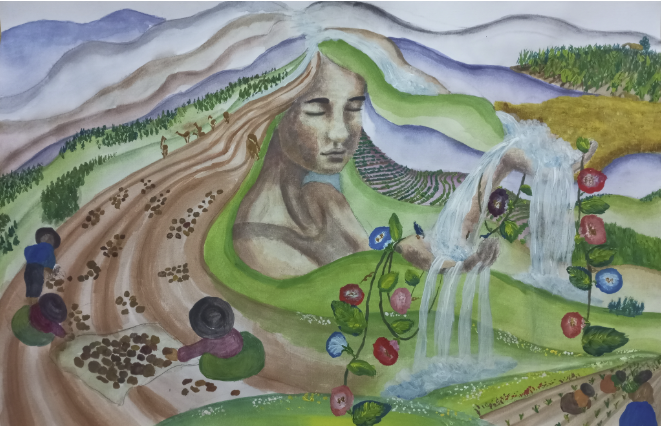
Centro de Estudios Regionales Andinos Bartolomé de Las Casas (2024).Visiones de la agroecología para el Buen Vivir. Compendio de obras de arte desde los países andinos para la educación popular. Ecología y desarrollo, 33.
This compendium brings together artistic works from Andean countries to advance popular education in agroecology. Rooted in the philosophy of Buen Vivir, it highlights creative expressions that connect ecological knowledge with cultural identity, community resilience, and collective wellbeing. By weaving art and agroecology, the volume underscores how visual and cultural practices can inspire transformative pathways toward sustainability and justice in Andean territories. Available in Spanish here.