JULY 2026
Dear Network Members,
This week’s newsletter is dedicated to sharing some insights and reflections that emerged from a panel on De-romanticising Agroecology: Feminist Critiques and the Building of More Viable Agroecological Futures two of us co-convened at the POLLEN 2026 conference in Barcelona.
First of all, we were all very surprised by the level of interest the panel received. The room was packed for the sessions and it was genuinely refreshing to witness such strong interest in engaging with feminist perspectives on the complexities of sustainable farming transitions. As one of our panellists noted, “we need to make sure that agroecology does not simply end up replicating injustices on a small scale.” This is precisely why we wanted to create space for these difficult debates: to digest, or perhaps “compost,” these thorny issues, and potentially reconstitute them in new and more transformative ways.
Across eleven presentations drawing on empirical case studies from Europe, Mexico, Zimbabwe, Ghana, the UK, and India, our panellists addressed a range of issues that we broadly grouped under five key themes. The first concerned labour and the work involved in sustaining agroecological farms on the ground, shining a light on how this labour is often underpaid, undervalued, and frequently feminised. From volunteers working on agroecological farms in the UK, to community-supported farming organisations in Portugal and Italy, to the unpaid time of family members producing bio-inputs in India, a recurring issue that emerged was the extent to which agroecological transitions often rely on invisible and precarious forms of labour. Central to these debates are questions around the need for agroecological actors to confront the ways in which they may be complicit in invisibilising labour practices, and to collectively consider the kinds of relations that we want to produce in agroecological transitions.
Questions of labour were closely connected to issues of land and land ownership structures, which frequently hinder agroecological transformation, particularly for the most marginalised members of communities. These discussions highlighted the structural inequalities that continue to shape who is able to participate in, and benefit from, agroecological transitions. Cases from the Majority world highlighted for instance how patrilineal systems of inheritance sit alongside landlessness and insecure land tenancy arrangement to compound barriers of participation in agroecological practices. Addressing these challenges points to the need to combine agroecological transition with structural demands for land reform and a broader definition of farmers beyond landowners, to include labourers, tenants, sharecroppers and all cultivators within a family.
Thirdly, papers critiqued structural interventions and top down policies that are increasingly co-opting agroecological farming practices. This included, for instance, discussions around the National Mission on Natural Farming in India, which disproportionately targets rainfed regions as “low-hanging fruit,” placing on already vulnerable communities the burden of transformation, while historically chemical-intensive agricultural regions are overlooked. In France, policies supporting farmers to transition to agroecology and sustainable farming practices are arguably creating new forms of dependency, which in turn obscure farmers' articulation for more autonomy over their farming practices.
Beyond these material dimensions of agroecology practice and transition, papers grappled with how feelings and broader affective dynamics create tensions around the meanings of agroecology and more specifically, how visions of the future, aspirations and hopes, collided with “reality” on the ground. For instance, for neo-rural women farmers in Spain and landless waged labourers in the UK practicing agroecology, experiences of deep emotional attachments to the land and more just visions of the future, which on one hand fuelled their political work, on the other, created a sense of “discontinuity” when met with the realities of operating amidst entrenched gender norms and capitalist systems. Many of the papers therefore illustrated how conflicting feelings, “affective ruptures” and “affect-cultures” impacted people’s participation in agroecology transitions and how political imaginaries took shape.
Drawing on these complexities and affective relations, several interventions put forward more radical imaginaries and political alternatives. From autonomy-centred pathways, to justice-oriented policy frameworks, as well as the radical imaginaries of queering acroecology, our panellists sought to remain true to a feminist ethos of generative critique: one that does not simply expose problems, but actively imagines more just and viable agroecological futures. To this end and amid a sense of despair about the reproduction of “agricultural exceptionalism” in agroecological worlds, we ended with a call for Queering Futurism in agroecology as a way to “rock the boat of agroecology,” advancing plural anti-normative, anti-capitalist and anti-colonial agroecological trajectories.
These insights suggest that deromanticising agroecology should be understood as a process rather than an end goal; a toolbox for critique and reimagination, a loose guide to build solidarities and modes of storytelling.
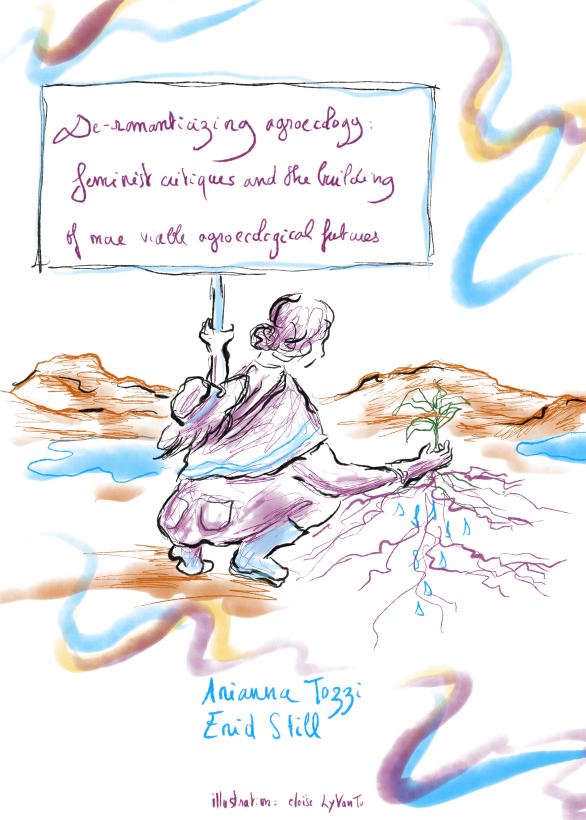
Alongside the panel, we were lucky to be joined by Éloïse Ly Van Tu, who captured each of the sessions in wonderful sketches which make the cover of our newsletter this month.
We hope you enjoyed this glimpse into our exciting panel and find the ideas thought provoking. Feel free to respond and start a conversation about any of the issues discussed via the list-serv - we would be very interested to hear what people think! Below you will find a couple of papers by our panelists and some upcoming events that we thought might be of interest.
Warmly,
Agrofutures Team
ACADEMIC ARTICLES
Nichols, C., & Kumari, N. (2026). Natural farming for whom? Environmental justice and state-led chemical-free farming promotion in India. The Journal of Peasant Studies, 1–27. https://doi.org/10.1080/03066150.2026.2643200
van Oers, Laura, Giuseppe Feola, Hens Runhaar, and Ellen Moors. 2023. ‘Unlearning in Sustainability Transitions: Insight from Two Dutch Community-Supported Agriculture Farms’. Environmental Innovation and Societal Transitions 46:100693. https://doi.10.1016/j.eist.2023.100693
Asiedu, Prince, Mirja Michalscheck, Bekele Hundie Kotu, Birhanu Zemadim Birhanu, Martina Padmanabhan, and Charity Osei Amponsah. 2026. ‘Responsible Scaling for Sustainable Intensification: Dimensions of Land Rights and Farmer Realities in Northern Ghana’. Land Use Policy 169:108151. https://doi.10.1016/j.landusepol.2026.108151.
EVENTS
The 4th International colloquium of agroecology and feminisms (CIFA): Confronting violence with feminisms, agroecology, and food sovereignty will be held on 2nd – 4th December 2026 in Brussels. The deadline to submit your proposal is on 31st August 2026. More information here.
The Land and Ecology Ethnographic Film Festival (LEEFF) will launch its inaugural event in London this autumn. The festival will focus on ethnographic films that “explore how people live with, shape, and are shaped by the land.” Unfortunately the deadline for submissions has passed but there will be more information about the exact dates and venues soon, so keep an eye on their website for more details: https://landecologyfilmfest.wordpress.com/
AGROECOLOGY AND ART
The cover of this month’s newsletter was drawn by Eloïse Ly Van Tu. Eloïse is a PhD candidate at the University of Amsterdam. She puts art and visual methods at the center of her research in animal exploitation and troubled ecologies. She is interested in collaborating with academics who desire to expand their work beyond words and academic walls through live drawn sessions, graphic workshops, illustrations, and comics.